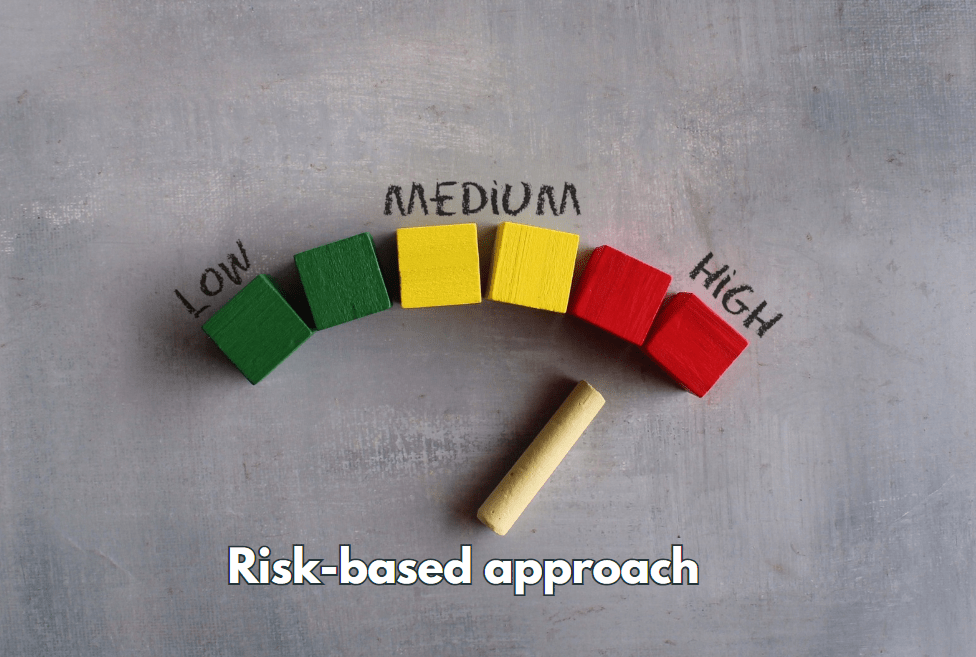
The risk-based approach is often explained as a classification exercise and it’s wrong.
Low risk, Medium risk, and High risk. If high risk — apply EDD.
That explanation is simple, and maybe wrong is too strong of a word, but definitely it is incomplete. In practice, RBA is not about labels. It is about how an institution uses its limited resources to reduce money laundering and terrorist financing risk.
Those resources are always limited. Analyst time. Management attention. Investigation capacity. System throughput. Even the amount of friction a business can absorb before it breaks. RBA exists because not everything can be reviewed deeply, all the time.
When RBA is treated as a labeling exercise, institutions miss its real purpose.

RBA as a resource-allocation model
A mature RBA does not ask only “What risk category is this customer?”
It asks “How much effort should we spend here compared to other risks?”
Higher risk should mean: more frequent reviews, deeper analysis, broader checks, and more senior involvement.
Lower risk should allow simplification. Fewer reviews. Lighter monitoring. Sampling instead of full coverage. Otherwise, resources are wasted where risk is low, and attention is stolen from where it matters most.
If risk tiers do not change how time, tools, and attention are allocated, the tiers are cosmetic.
The hidden cost of false “high risk”
Many institutions believe that classifying more customers as high risk is conservative. In reality, it creates a system-level problem.
When too much is labeled high risk, workload grows faster than capacity. Queues get longer. Analysts rush. Investigations become shallow. Escalations are delayed. True high-risk cases receive the same attention as marginal ones.
This is not caution, but congestion.
If everything is urgent, nothing is urgent… prioritized. If everything is high risk, high risk loses meaning. The result is more activity, but less insight. More alerts, but weaker detection. Compliance noise replaces signal.
Signal versus noise is not theoretical
AML systems can be very good at generating work. That does not mean they are good at identifying risk.
Noise comes from blunt categorization, static thresholds, uniform monitoring, and scenarios that detect what is “unusual” but not what is truly suspicious. Over-classification amplifies that noise. Signal comes from context. From behavior that does not make sense for the customer’s profile, income, business model, or geography. Signal is predictive. Noise is distracting.
A strong RBA increases signal density — the proportion of effort spent on meaningful risk. If an alert does not change a decision, it is probably noise. If a risk tier does not change monitoring design, it is decoration.
More alerts do not mean better detection — they often mean more noise.
What a real RBA looks like
A real risk-based approach:
- allocates effort based on expected risk, not fear,
- allows simplification for genuinely low risk,
- sub-segments high risk instead of treating it as one bucket,
- reallocates resources dynamically when risk changes.
Most importantly, it treats RBA as an operating model, not a compliance slogan.
Calling everything high risk is not conservative. It is mathematically reckless.
RBA only works when risk is truly assessed — and when resources are deliberately placed where they reduce harm the most.




 Compliance Ninja
Leave a comment